Mount Your Cloud As A Drive On Mac And Windows
Open, edit, and save files straight off Files.com in Finder or File Explorer. Files stream in the moment you open them, so you work off your entire cloud without ever filling your disk.

One Drive For Every Cloud, Right On Your Desktop
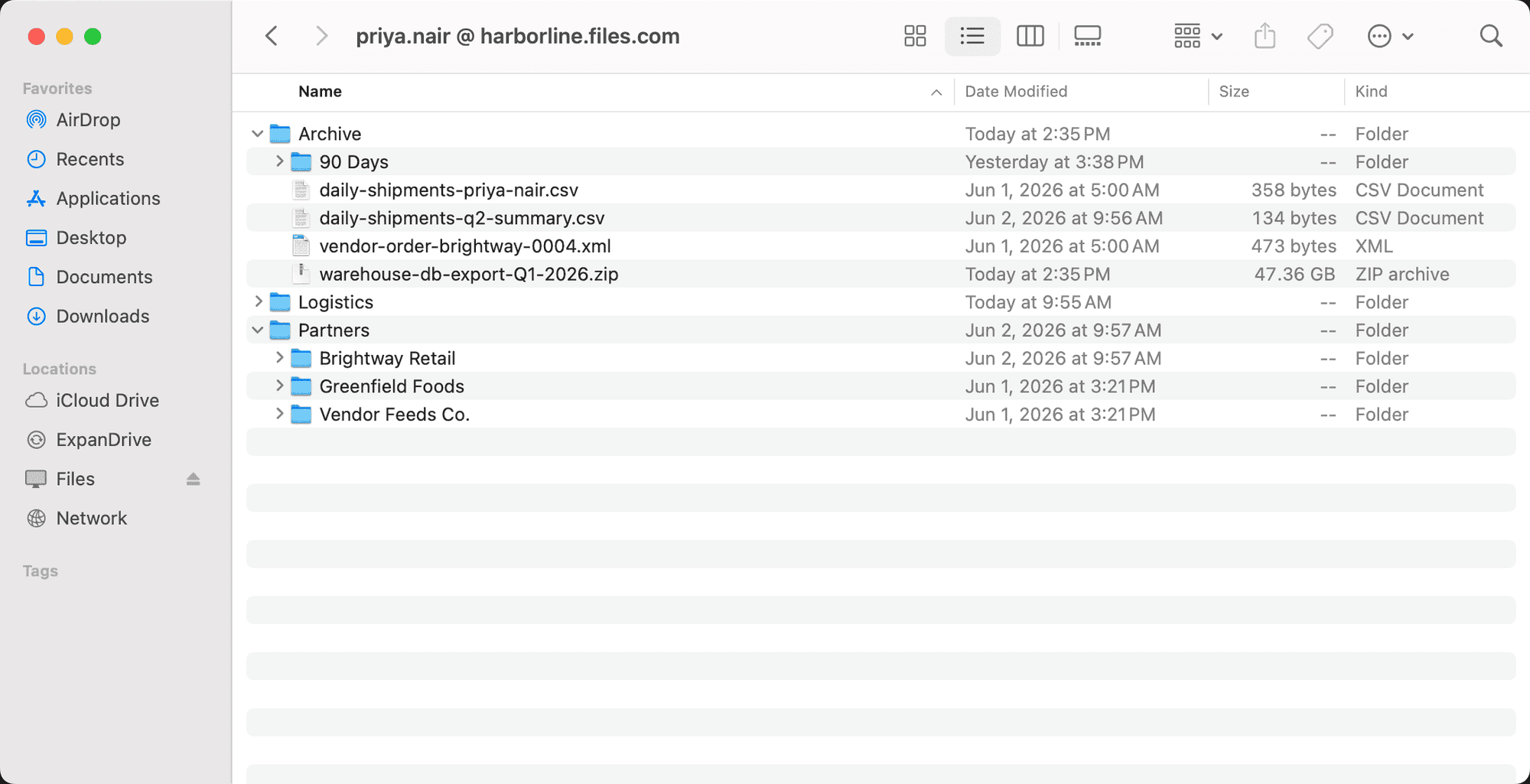
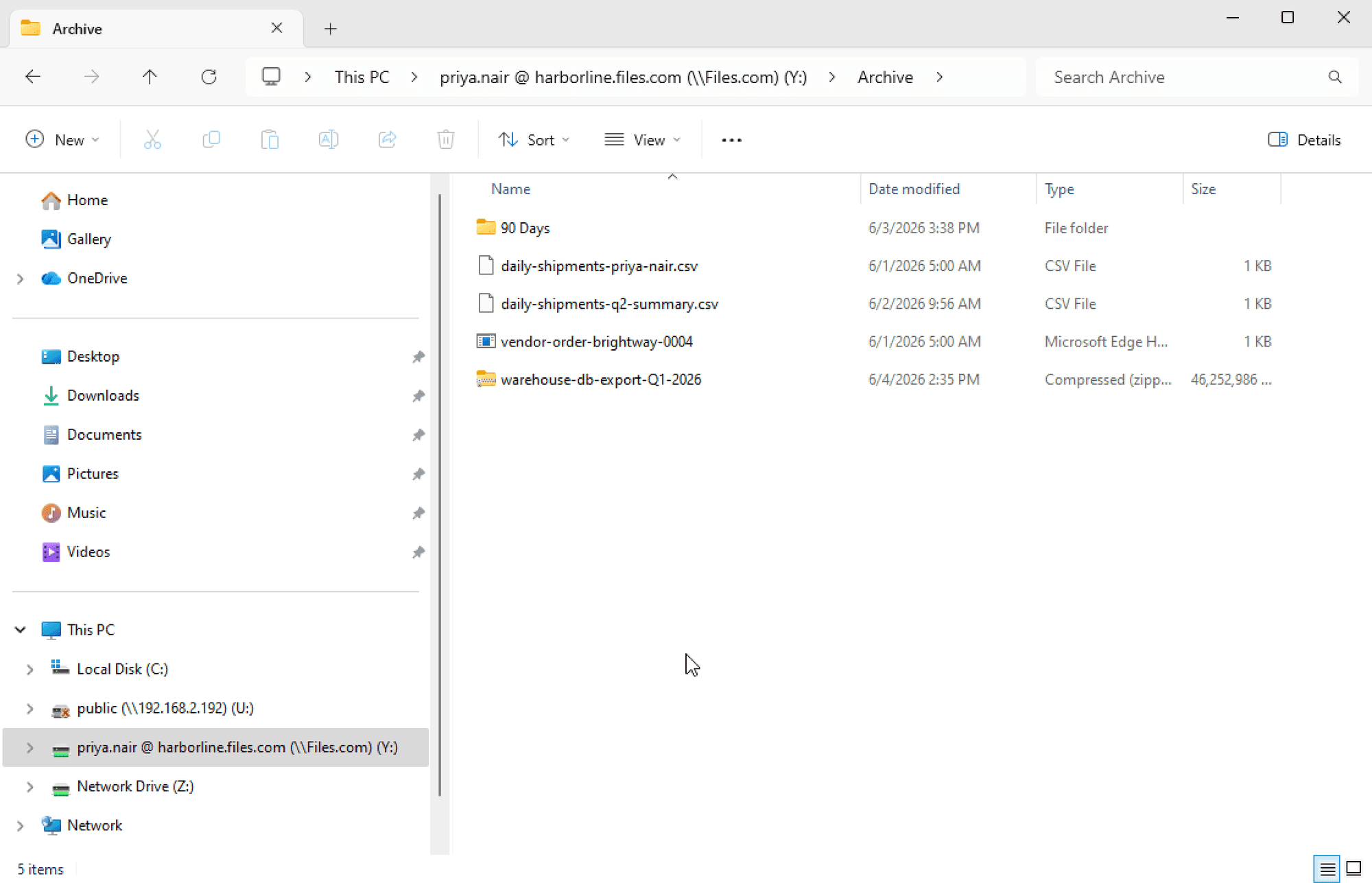
Install the Files.com Desktop App once. Every storage backend you have connected then shows up as a single drive in Windows File Explorer or macOS Finder. SharePoint, OneDrive, Google Drive, Amazon S3, Azure Blob, and your on-premise file servers all sit in one place. You open, edit, and save files the same way you handle anything else on your computer, so there is no new tool to learn.
Today your team reaches the cloud from the desktop through a clunky pile of tools. FTP clients stall on big files. Per-vendor sync apps scatter shadow files across the disk. WebDAV mounts barely work, and the aging file server still sits in the closet. The Desktop App replaces all of it with one drive, so you cut the tool sprawl and the support tickets that come with it.
We have done this longer than anyone. Files.com owns ExpanDrive, which has mounted cloud and remote storage as a desktop drive since 2004. That predates Dropbox, Box, and OneDrive. We helped create this category, and we lead it. The Desktop App is included on every Files.com plan.
Your Files, Right In Finder And File Explorer
Your cloud opens as a normal drive in the file manager you already use. Browse, open, edit, and save the same way you handle local files, on macOS and Windows. There is no separate app window to learn. On the go, the Files.com mobile app gives you the same access from your phone.
Three Modes, For Three Different Jobs
The app works three ways, and the right one depends on what you are doing. Most days you live in Mounted Drive Mode. Reach for the other two when the job calls for it.
Mounted Drive Mode
Files.com shows up as a normal drive in Finder or File Explorer. Files stream in when you open them, so they behave like local files without filling up your disk. Double-click to open, Save-As writes straight back to the cloud. No forced background sync, no shadow files.
Turbo Transfer Mode
A high-speed drag-and-drop window for moving large files and big batches fast, with resumable transfers and smart retry. Turbo Transfer is two to five times faster than third-party SFTP and FTP clients, so it replaces the FileZilla and WinSCP installs people use for multi-terabyte media libraries and archives.
Sync Mode
Keeps a folder on your desktop and a folder in the cloud matched, moving only the files that changed. It is built to handle very large folders reliably. Reach for it when you genuinely want a synced local copy instead of streaming files on demand.
Every Connected Cloud, In One Drive
Whatever storage you have linked to Files.com shows up as one native file system. No per-service client to juggle, no figuring out where a file actually went.
Built For Real Teams And Real IT
The app looks simple on the surface, but the same controls that run the rest of Files.com run behind it.
Edit Cloud Files In Your Real Apps
Open a file from the mounted drive in Word, Excel, PowerPoint, Photoshop, Premiere, Illustrator, AutoCAD, or SketchUp. Your edits save back to the source cloud. There is no download-edit-upload cycle.
File Locking Built In
Opening a file through the mapped drive sets a lock the Desktop App and the Files.com web editors respect, so two people do not overwrite each other on a shared cloud file.
Same Engine As The CLI
The app runs on the same transfer engine as the Files.com CLI and SDKs, so anything you do by hand in the app, your team can automate in code with identical behavior.
Your On-Premise Servers Too
The Files.com Agent bridges your existing file servers and NAS into Files.com, so an old server is reachable from any laptop through the same drive, without ripping out the hardware.
Built For IT To Deploy
Push the app with GPO and ADMX templates, Microsoft Intune, Jamf Pro, or SCCM. Silent installs and zero-touch automatic updates are managed from the admin console, so you roll it out to a whole fleet without touching each machine.
Governance Follows Every File
Every action runs through the Files.com control plane, so single sign-on, multi-factor authentication, role-based access, audit logging, and retention rules apply no matter where the file physically lives.
Where Teams Reach For It
Across the customers Files.com has profiled, the Desktop App is how a person reaches a governed folder as a drive. These are the jobs it shows up in most.
The Bucket Opened As A Folder
Analysts, account managers and operations staff open the company’s S3 or Azure bucket as a drive with single sign-on, so the engineer who used to copy files out of the console by hand stops being the interface. That is the people side of a cloud storage gateway.
Drive Letters That Outlive The Filer
When the office file server is retired, the same drive letters and paths keep resolving on every workstation, streamed rather than synced, which is what makes file server replacement invisible to the people who use it.
CAD And Plan Sets Opened In Place
Engineers open multi-gigabyte drawings and plan sets from the drive in the application they already use, with file locking so two people never overwrite each other, and the exchange with clients and contractors runs from the same folder tree.
Artwork And Footage Moved At Size
Creative teams and editors drop layered artwork and raw footage onto the drive and Turbo Transfer moves it over parallel connections, so the exchange with agencies and printers and the delivery to broadcast partners run at line speed from the desktop.
One Drive To Every Client’s SFTP
Staff who used to hold a dozen clients’ SFTP credentials reach each client’s server as a folder on the drive, through a remote mount the administrator set up once, so nobody carries a partner’s password on a laptop and every upload is logged under the employee’s own name.
Desktop App Questions
One Desktop App For Every Cloud
Download the app, sign in, and your cloud shows up as a drive in Finder or File Explorer in minutes. Or start a 7-day free trial and connect your storage first.
No credit card required • Free for 7 days • Live in minutes