Copy, Move, Or Delete Files
Copy a file to one place or several at once, move it, or delete it after it has been handed off. One workflow can fan a single arrival out to multiple destinations.
Files.com Automations move, copy, route, and clean up files on their own. They run the moment a file arrives, on a schedule, or when an app calls in, so you can retire the cron jobs and glue scripts that quietly run your business. Build a workflow in the browser, point it at any of 50+ systems, and let it run with automatic retries and a full record of every step. No code required, no fragile scripts to maintain.
Most companies have a pile of machinery that moves files between systems: Bash and PowerShell scripts, cron jobs, a Lambda function or two, maybe an expensive integration platform. It breaks easily. It fails quietly. And usually one person understands it. The day that person leaves, you are exposed.
Files.com Automations take that work over and put it on a supported platform. A file arrives, a schedule rolls over, or an app calls in over a webhook, and the workflow runs: copy, move, delete, or route the file to another system. Every run retries on failure and lands in the audit log with the trigger, the files touched, and the outcome. No more glue code, no more tribal knowledge living in one engineer’s head.
“It’s easy to handle automation around encrypted files and ensure they end up in the right spot, at the right time.”

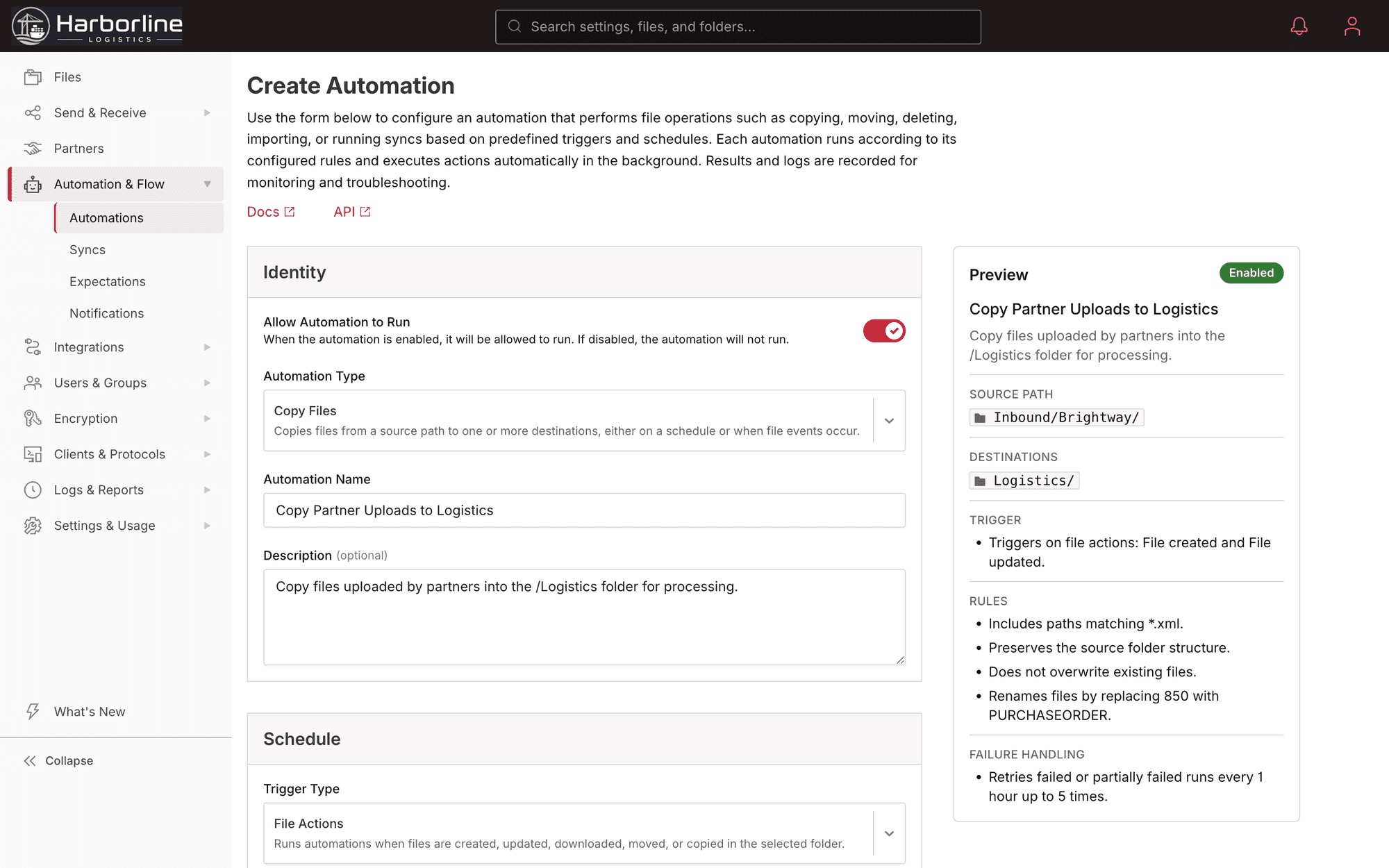
Pick the trigger, the source, and the destination, set the filters and the schedule, and a live Preview spells out exactly what the automation will do before you turn it on. No script to write and nothing to deploy.
When you would rather define it in code, the same automation is reachable through the API and SDKs and a Terraform provider.
A workflow fires on the event that matters to you: a file landing, the clock, or another app reaching in.
A partner uploads over SFTP, FTPS, FTP, WebDAV, or the API, and the workflow fires the moment the file lands. Nobody watches the folder and nobody runs a script: the drop itself starts the work.
Run a workflow daily, weekly, monthly, quarterly, or yearly. Pick the time, the time zone, and a window for it to run in. It can even skip holidays for a region you choose, so a payroll run doesn’t fire on a bank holiday.
Another app sends a webhook, a quick web request that says “go,” and the workflow runs. That’s how a SaaS tool in your stack kicks off a file workflow without anyone touching it.
Copy a file to one place or several at once, move it, or delete it after it has been handed off. One workflow can fan a single arrival out to multiple destinations.
Send files out to S3, Azure Blob, Google Cloud Storage, a partner’s SFTP server, or onto your own machine in the office through the Files.com Agent. Over 50 systems are reachable as a destination.
Use wildcards in the path so one workflow covers a whole folder tree instead of a single folder. Set the rule up once and it handles every matching file from then on.
A transfer hiccup doesn’t mean a dropped file. Files.com retries failed runs automatically and records every attempt, so a flaky network doesn’t turn into a 2 a.m. page.
An integration platform like Boomi, MuleSoft, or Zapier only shows your point of view. Your partner can’t log in, can’t see the logs, and can’t fix their own side. So every “why didn’t my file arrive?” routes back through your IT team, forever.
On Files.com the partner is on the same platform as the workflow. They get their own login. They can see what ran, read the logs that apply to them, and fix most things themselves, so your people stay out of the middle of every question. For deeper control, every workflow is also reachable through the API and SDKs.
Scheduled feeds between business systems and their counterparties are the second most common job on Files.com, and Automations are what run them.
The ERP or HRIS drops its nightly extract into a folder. An Automation renames it, moves it to the landing path the warehouse job reads, and the load runs on arrival instead of on a guess about when the export finished.
Order, invoice, and inventory files fan out from one export to each partner’s folder or SFTP endpoint, under each partner’s filename convention and encryption mandate, with one log for all of them.
A partner’s upload fires a webhook or a move into the intake folder your application watches, so the pipeline starts on the event rather than sweeping the folder every few minutes.
The cron job, the PowerShell task, and the Lambda function that moved files between systems become Automations a whole team can read, with retries and a log, so the person who wrote them can finally leave.
Common questions about building file workflows on Files.com: how they trigger, what they do, and what makes them more dependable than the scripts they replace.
A Files.com Automation is a file workflow that runs without anyone pressing a button. A trigger fires when a file arrives, a schedule rolls over, or an app calls in over a webhook. Then an action runs: copy, move, delete, or route the file to another system. Every run is logged, retried on failure, and visible in the audit trail. How Automations replace file-transfer scripts shows the common patterns.
One Files.com Automation can cover a whole folder tree. Paths match with wildcards (*, **, ?, and character sets like [A-Z]), so you never list every folder by hand. Set the rule once and it handles every matching file from then on.
Files.com retries a failed Automation run automatically, up to three times with increasing backoff. Every attempt lands in the audit log: the trigger, the files touched, the destination, and the outcome. A flaky network or a partner server that blinks offline does not become a silently dropped file.
Files.com gives your partner their own login, so they can see the workflow, read the logs that apply to them, and fix most things without your IT team in the middle. An integration platform like Boomi, MuleSoft, or Zapier only shows your point of view. Your partner cannot log in, cannot see the logs, and cannot fix their side, so every “why didn’t my file arrive?” routes back through your people.
Automations are built and managed in the Files.com web interface, with no code to write. An operator who owns the files sets up a workflow without filing a ticket with engineering. Developers who want full programmatic control still have it through the API, and the no-code path covers most workflows on its own, which is what removes the operational cost of scripted file workflows.
Automations are available on every Files.com plan: Starter, Power, and Enterprise. The number of included workflows, how many run in parallel, and how often scheduled runs fire all scale by plan, and you can buy more.
Yes. A file arriving over SFTP is a first-class trigger. The Automation can move or copy the file into the folder your application watches, rename it to the convention the loader expects, and a webhook can tell your orchestrator to start the run with the path in the payload. The partner’s upload becomes the event that starts your pipeline.
Give each system a service account and a folder on Files.com, then rebuild each script as an Automation: the same source pattern, the same destination, the same schedule or arrival trigger, with retries and a log the whole team can read. Move one flow at a time while the scripts keep running, and land the inbound partner feeds in the same storage your pipelines already read.
The glue scripts won’t retire themselves. Build your first workflow in the browser, turn it on, and from then on the files move on their own and every run is logged.
No credit card required • Free for 7 days • Live in minutes