Routing Connections
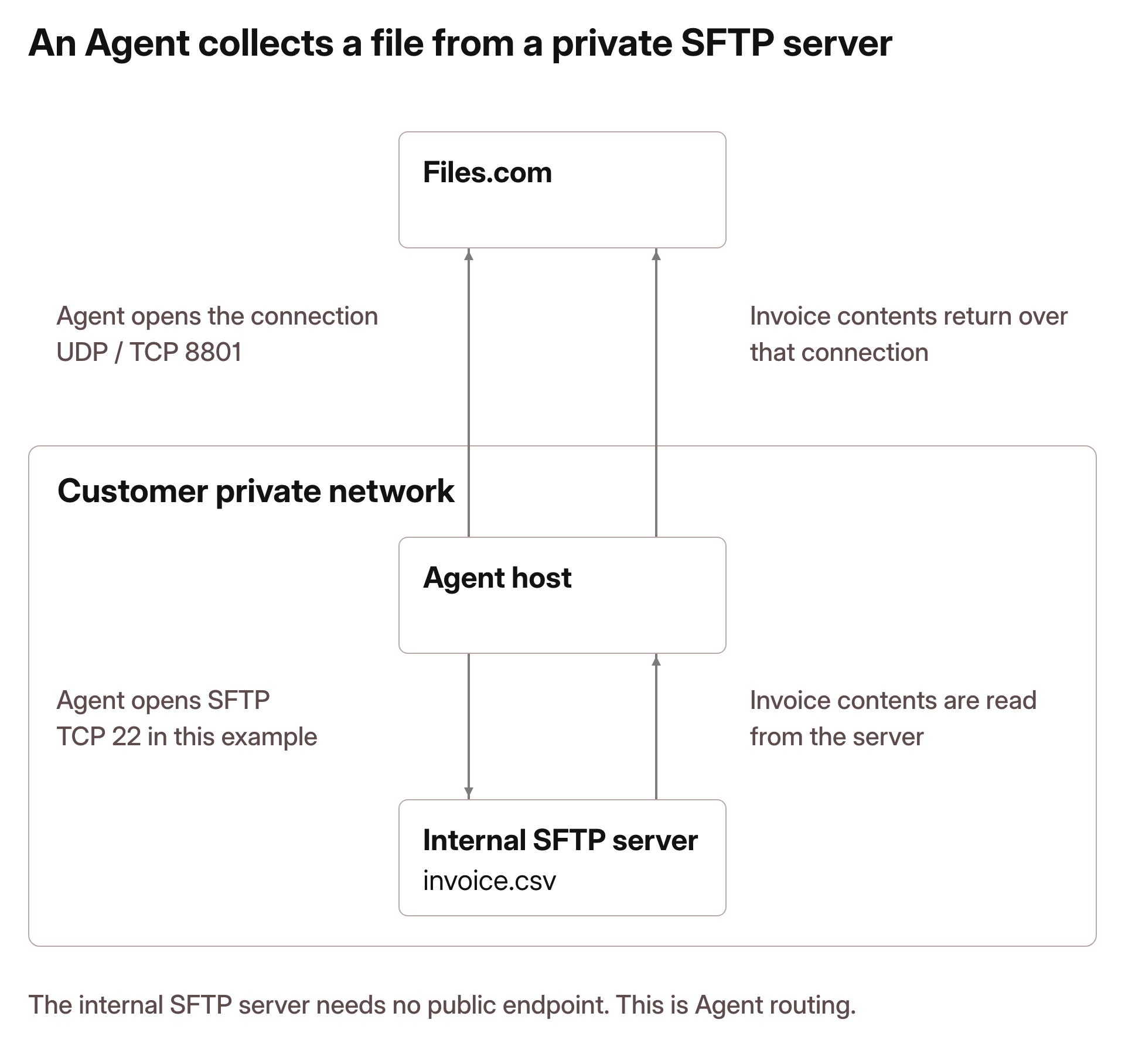
The Files.com Agent connects your Files.com site to internal servers without VPNs, VPC peering, firewall openings, or network redesign. Use it when Files.com needs to reach private infrastructure that cannot be exposed to the public internet.
Traditional approaches to this problem rely on VPNs, VPC peering, private endpoints, or inbound firewall rules. These work, but they add network services and access rules to configure and maintain. Agent-routed connections remove those requirements. The Agent makes outbound connections only, so no inbound firewall ports are opened and no private networking constructs need to be managed.
How It Works
When Agent routing is enabled, the Files.com platform never connects directly to the internal server. Files.com sends operations over the connection the Agent established, and the Agent opens the session to the internal server. The internal server does not need a public IP address and does not accept inbound connections from the internet.
Users and Automations interact with the Remote Server the same way they do with any other integration. File transfers, directory listings, and metadata operations behave identically.
Supported Connections
The Agent host must be able to reach the destination service and its configured port. The destination must accept the Agent host's connections. Configure each service's own credentials and access rules on its Remote Server.
| Connection | Integration value | Network requirements from the Agent host |
|---|---|---|
| SFTP | "sftp" | The server's SFTP port, typically TCP 22. |
| FTP and FTPS | "ftp" | The server's command port, typically TCP 21 for explicit FTP(S) or 990 for implicit FTPS, and its passive data ports. |
| WebDAV | "webdav" | The server's HTTP(S) port, typically TCP 443 for HTTPS. |
| Cloud storage | The matching value below | The storage service and its buckets, typically TCP 443. |
Cloud Storage Integration Values
| STORAGE | VALUE |
|---|---|
| Akamai Linode | "linode" |
| Amazon S3 | "amazon_s3" |
| Backblaze B2 | "backblaze_b2" |
| Cloudflare R2 | "cloudflare" |
| Filebase | "filebase" |
| Google Cloud Storage (GCS) | "google_cloud_storage" |
| Google Cloud Storage (GCS) with HMAC | "gcs_s3_compatible" |
| Google Drive | "google_drive" |
| Microsoft Azure Blob | "azure_blob_storage" |
| Microsoft Azure Files | "azure_files" |
| S3 Compatible | "s3_compatible" |
| Wasabi | "wasabi" |
Enabling Routing
Edit the Agent configuration file and set integrations to the connection types your workflows need. For example:
integrations = ["sftp", "amazon_s3", "azure_blob_storage"]
The value ["all"] enables every supported routing type. This expands the services the Agent host can access; specify only the required types in most environments.
Save the file and restart the Agent so it advertises the enabled routing types to Files.com. Until it restarts, the previous configuration remains in use and newly enabled types are unavailable.
Create or edit the destination Remote Server in Files.com. Enter the server's internal hostname or IP address, or the cloud service's connection information and credentials. Enable Agent routing and select the Agent that can reach that destination. Files.com then sends this Remote Server's traffic through that Agent.
Transfer Performance
Agent-routed connections improve transfer speed compared to direct SFTP, FTP(S), or WebDAV access over the internet. These protocols are chatty and latency-sensitive. Files.com transfers data to the Agent using an optimized connection for the longer path, and the Agent performs the protocol transfer locally within your private network, where latency is low and bandwidth is high. This removes the protocol's performance bottleneck from the long-haul portion of the transfer.
Eliminating Inbound Connections from the Internet
Agent-routed connections keep the internal server fully private. The server does not need a public endpoint. The Agent host initiates the connection to the server using the Remote Server’s configured credentials, within the access rules you set for your private network.
You retain full control over which internal systems the Agent can access. Authentication, encryption, and access controls remain unchanged, and Files.com never requires inbound access to your private network.