Give Every File A Lifecycle, Not A Liability
Decide how long files live, when they get archived, whether they can be overwritten or deleted, and whether old versions are kept. You set it folder by folder, with no custom cron jobs and no retention premium on the storage bill. Set nothing and files just sit there. Turn the controls on where you need them and Files.com enforces your policy automatically, even on storage it does not host.
Retention Rules You Already Have, Enforced Automatically
Most teams already know what their retention rules are supposed to be. HIPAA wants six years of audit records, SOX wants seven years of financial records, GDPR wants old personal data minimized and disposed of. The hard part has always been making the platform actually do it without someone manually archiving folders or babysitting a cleanup script. Files.com enforces the retention rules you already have, automatically, and only the ones you switch on.
None of this is a UI-only toggle. Every control is exposed through the web admin, the REST API, CLI, and SDKs, and Terraform, so you can manage retention policy as code alongside the rest of your infrastructure, or click it on in the admin UI. Whichever fits how your team works.
A retail and commercial bank made Files.com its governed archive tier: nightly pushes move records off the bank’s SAN, and per-folder expiration rules enforce a different retention clock for syslog archives, historical records, and call recordings automatically.
The Controls You Switch On
Each one is optional and off by default. Turn on only the controls you need.
Per-Folder Expiration
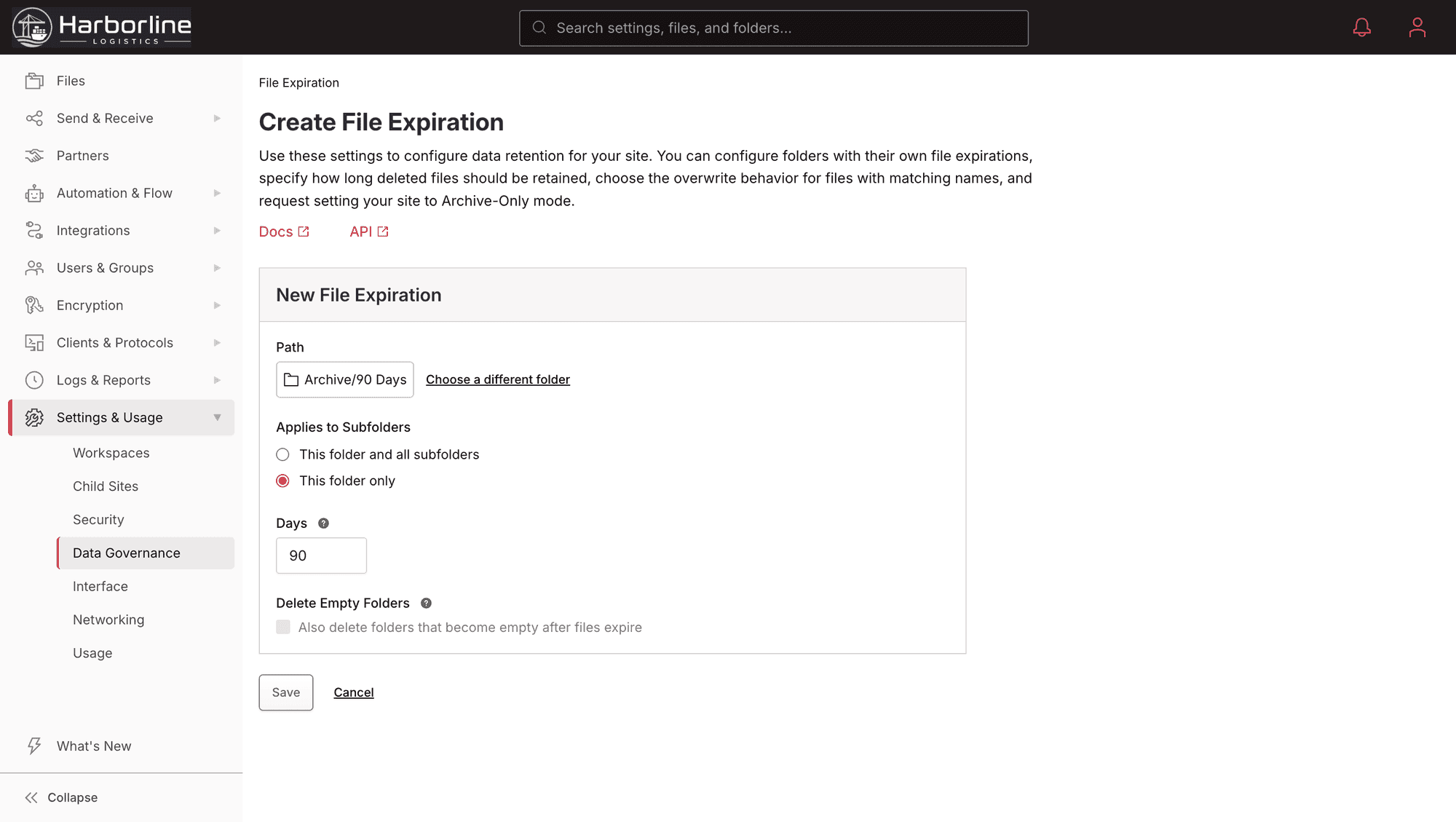
Turn it on for a folder and files automatically get deleted, archived, or moved to cheaper storage once they hit an age you set. Subfolders inherit the rule unless you override them. Because each folder runs on its own clock, one site can hold tax records for seven years, invoices for two, and marketing drafts for thirty days.
Version History
Keep prior versions of files that get overwritten, in the folders where you want them. When a bad save or a runaway automation clobbers the real file, yesterday’s version is still there to restore.
Archive Removed Files
When this is on, a deleted file goes into an archive area for a window you set. It does not matter what removed it: a person, an automation, or an expiration rule. Deletion stays reversible until that window closes, so an accidental delete is a click to recover, not a support ticket and a restore from backup.
Archive-Only Mode (WORM)
Put a site in Archive-Only Mode and it becomes write once, read many. Files written into it can never be modified or deleted, by anyone. The mode is irreversible by design, so it holds up as a legal hold and as a tamper-proof backup destination. Run it on a dedicated child site alongside your working site.
Overwrite And Naming Rules
Decide what happens when an upload’s name collides with an existing file. Keep both, overwrite in place, or reject it. You can also restrict which filenames and extensions a folder will accept, so a job expecting a .csv never chokes when someone drops in a .xlsx. The rule keeps the bad file out before it reaches the automation.
Checksum Verification
Files.com can compute and verify SHA-256, SHA-1, MD5, and CRC checksums on transfer. You get proof a file arrived exactly as it left, which is the integrity record a compliance review expects.
Govern Storage You Don’t Even Host
Here is the part most teams do not expect: Files.com can add retention and lifecycle management to storage it does not host. Mount an S3 bucket, an Azure Blob container, a SharePoint library, OneDrive, Google Drive, Box, Dropbox, or an on-prem source through the Files.com Agent and Remote Server Mounts, and the same per-folder expiration, archival, and overwrite rules apply to that data. The bytes stay in the other system. The policy does not care where the data physically sits, so you can finally put lifecycle rules on years of un-governed S3 or SharePoint without moving any of it.
And retained data is not a profit center. Archived and versioned data is billed as ordinary stored data, with no compliance-storage surcharge, and you can route archives to cheaper external targets. For point-in-time immutable copies of a specific set of files, the kind a legal hold or an external-storage backup needs, pair this with Snapshots.
A call recording archive is the sharpest case: years of recordings in your own cold storage, each class expiring on its own clock, with Files.com in front as the login wall and the log.
How Teams Put Exchanged Files On A Clock
Four retention patterns account for nearly every customer who moved cleanup and archiving off scripts and onto rules.
Drop Folders That Empty Themselves
Partner and client exchange folders expire files 30, 60 or 90 days after arrival, so regulated data stops accumulating on the transfer layer and the nightly cleanup script is retired. The folder is clean because the rule ran, not because someone remembered.
An Archive Copy Where The Mandate Says
After pickup, an automation moves the file to an archive folder, your own S3 or Azure bucket, or an on-premises server, and the exchange copy expires, so the seven-year record lives where you chose and nowhere else.
Retired Systems And Closed Projects, Kept Cold
Mailbox exports, the dump from a decommissioned application and closed-project files land in a read-only, versioned archive on cheap storage, reachable over SFTP and the browser the day legal or finance asks.
Sensitive Files Held Only In Transit
PGP-encrypted deliveries decrypt for the receiving system, log to the SIEM and expire within hours, so the file exchange never becomes a second copy of the data it carried.
Data Retention Questions
What teams ask about turning controls on, governing external storage, what it costs, and how legal holds work.
Every Files.com retention and lifecycle control is off by default. Turn a control on where you need it and Files.com enforces it automatically from then on. A single site can mix seven-year holds and thirty-day cleanups without any custom scripting.
Files.com applies retention and lifecycle rules to storage it does not host. Mount an S3 bucket, Azure Blob container, SharePoint library, OneDrive, Google Drive, Box, Dropbox, or an on-premise source through the Files.com Agent, and the same per-folder expiration, archival, and overwrite controls apply to that data. The bytes never live on Files.com. A team with years of un-governed data in raw S3 or SharePoint can point Files.com at it and put every folder on its own clock, without moving a byte.
Files.com bills retained, archived, and versioned data exactly like any other stored data. There is no retention premium. Turning on version history or a long archive window does not move data into a punitive pricing tier, and you can route archived data to cheaper external targets like S3, Azure Blob, or Wasabi. Per-GB rates are published on the pricing page.
Files.com Archive-Only Mode enforces immutability as platform behavior: once files are written, they cannot be modified or deleted. It is not a separately certified WORM product against SEC Rule 17a-4(f) or FINRA Rule 4511 today. If your regulation specifically requires that certification, contact sales. That is a contractual conversation rather than a setting.
Files.com supports a legal hold three ways, and you pick what your legal team prefers: freeze permissions on the target folder, sync the folder to a separate Archive-Only Mode site, or take a point-in-time snapshot that captures the files exactly as they were the day the hold began. For eDiscovery, the API also lets you find the relevant files, preserve them, and collect them programmatically.
Files.com governs retention-policy changes with the same single sign-on, multi-factor, and role-based access controls that govern who can read or change files. Every policy change is itself a logged, auditable event in the immutable audit log, so you always have a record of who altered a rule and when.
Set a retention rule on the folder in Files.com. Files older than the window you choose are removed automatically, subfolders that need a longer clock can be exempted, and each deletion is recorded in the audit log. The rule applies to files arriving over every protocol, and the same rule can archive instead of delete.
Pair a folder automation with a retention rule. The automation copies each file on arrival to an archive folder, or to your own cloud bucket mounted as a folder, and the archive’s retention holds the copy for seven years, with Archive-Only Mode if the record must be unalterable. The exchange folder itself can expire files in days.
Yes, within the window you set. Files.com keeps deleted and overwritten files restorable for the retention period you configure, so a partner’s accidental delete or a bad overwrite is undone from the web app without a support ticket.
Put Your Files On A Clock
Start a 7-day free trial, set an expiration rule on a folder, and watch Files.com enforce it automatically. Govern native storage and your mounted S3, Azure, and SharePoint data from the same place.
No credit card required • Free for 7 days • Live in minutes